The Best Photoreactors for Screening Photochemical Reactions
Numerous variables play a key role in photochemical reactions: wavelength, light intensity, time, temperature, stoichiometry and more.


Rowan M. Bailey evaluates the PhotoChip LED photoreactor whilst conducting kinetic sweeping experiments which rely on highly reproducible reactor conditions.
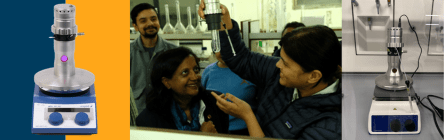
Asynt visited the Cresswell group at the University of Bath’s Chemistry Department, to film their labs and interview some of the students using Asynt equipment for their research. Here are the videos from our visit.
Isla Gow from the University of Cardiff shares details on her photochemistry research in collaboration with NAST, using the Asynt Lighthouse batch photoreactor.
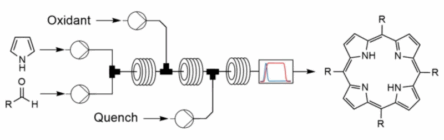
Chemists from the University of Liverpool tackle the challenges of synthesizing porphyrin derivatives.
Flow chemistry and photochemistry are both being increasingly utilised in synthetic chemistry. Flow chemistry allows for safer, more controllable processing and easier scale-up. Photochemistry has opened up novel routes that can be cleaner and more energy-efficient than standard synthesis.
Photochemistry has consistently grown as a field of research across the last couple of decades, opening new avenues of synthetic catalysis. Asynt are keen to support chemists in this expanding area of research by providing precise photochemical tools, but why not just make your own?
Flow chemistry and photochemistry are both growing areas of research. Both processes opening new novel synthetic routes.
Parallel synthesis plays a central role in compound development across a range of chemistry fields and industries, from pharmaceuticals to fragrance.
Combining photochemistry with flow chemistry is the natural progression from the growth of these two fields in recent years. Doing this enables safer, more efficient, and scalable processes.