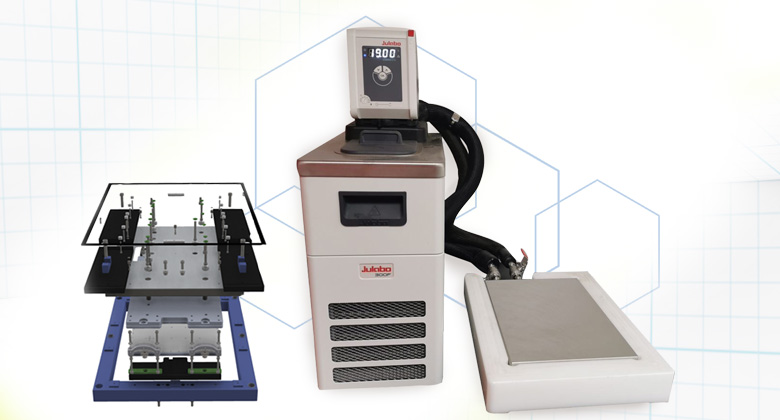
Thermal Testing Assemblies
Bespoke thermal testing assemblies for battery and electronics R&D. Precise, repeatable temperature control at the point of test. Asynt designs and builds cold plates, test fixtures and complete liquid temperature control loops for battery, power electronics and aerospace research.
Every assembly is engineered to your specification and paired with a Julabo temperature control unit chosen from their comprehensive range to match your exact requirements, so your device under test sees exactly the thermal profile you programme.
Contact our engineering R&D team today to discuss your requirements.
Worldwide shipping – our logistics experts deliver!
Why temperature control at the device matters
An environmental chamber sets the air around a sample. Many R&D tests also need to control the surface the sample sits on, because that is how heat leaves a cell or power module in service. A liquid cooled plate driven by a dynamic temperature control system lets you:
- Hold a defined base temperature while a cell is charged and discharged
- Run programmed thermal cycles at a controlled ramp rate
- Reproduce the cooling conditions of a real battery pack or inverter
- Measure heat generation and cooling performance under repeatable conditions
Combined with a battery cycler and, where needed, a climatic chamber, the result is a test cell where thermal and electrical profiles can be run together.
Applications
Battery cell, module and pack testing. Cold plates and fixtures for pouch, prismatic and cylindrical cells, through to module and pack test beds. Typical uses include thermal cycling, performance and ageing tests at controlled temperature, cooling curve and heat generation studies, and comparing base cooled with side cooled configurations.
Power electronics. Temperature controlled mounting plates for IGBT, SiC and GaN modules, inverters and DC to DC converters. Suitable for characterisation work and for holding a defined coolant temperature during power cycling and reliability studies.
Automotive and electric mobility. Component and subsystem testing for EV and hybrid programmes, including battery, drivetrain electronics and sensors. Typical automotive validation windows run from around −40 °C to +85 °C; Asynt assemblies can be specified for working temperatures from −80 °C to +300 °C, depending on the Julabo unit selected.
Aerospace and defence. Thermal cycling of avionics, sensors, optics and material samples where tight temperature stability and controlled ramp rates are required.
Academic and institute research. Flexible test rigs for battery chemistry, thermal management and materials research groups, built to fit existing cyclers, chambers and data acquisition.
What we design and build
- Liquid cooled cold plates and temperature controlled platens sized to your cell, module or component
- Tool plate mounting surfaces where flatness and stability matter
- Construction in non silicone materials for contamination sensitive applications
- Clamping fixtures that apply defined, even contact pressure to the device under test
- Insulated enclosures and covers to reduce heat loss and condensation
- Multi station manifolds so one circulator can serve several test positions
- Sensor positions for thermocouples or Pt100 probes at the points you need to measure
- Selection and supply of the matching Julabo temperature control unit and heat transfer fluid
Working with your cycler and chamber
Julabo temperature control systems provide standard interfaces including RS232, USB, Ethernet, analogue and external Pt100 sensor input, depending on model. This allows the circulator to be controlled from, or synchronised with, your battery cycler or test management software, so thermal and electrical profiles run together.
Our staged design process
- Requirement review. We discuss the device, test method, temperature range, ramp rates and heat load with you.
- Concept and thermal approach. Working with Julabo, we propose the plate, fixture and temperature control unit best suited to your test.
- Detailed design. You receive comprehensive drawings to review and approve before manufacture.
- Manufacture and assembly. Manufactured and checked in Asynt’s own engineering facility.
- Delivery and support. Shipped worldwide, with installation guidance and ongoing technical support.
Why Asynt
- Assemblies supplied to multiple aerospace and automotive R&D programmes, always in confidence
- More than 20 years designing and supplying laboratory temperature control equipment, founded in 2003
- Partnership with Julabo, giving access to their full range of temperature control units
- Design and manufacture in our own engineering facility, with engineers and chemists who understand both the thermal and the experimental side of your test
- One supplier for the fixture, the circulator and the integration
- Worldwide shipping and support, with a US presence through Asynt Inc.
Frequently asked questions
Are your thermal testing assemblies standard products?
No. Every assembly is designed to the customer’s specification, device geometry and test method.
What temperature range can you achieve?
Assemblies can be specified from −80 °C to +300 °C. The exact range for your test depends on the Julabo unit selected and the heat load of your device, so tell us your required range and ramp rate and we will propose a suitable combination.
Can you work to a test standard?
We design the hardware to support the conditions your method requires. Tell us the standard or internal procedure you are following, for example IEC 62660 for EV cells, and we will design around it. Compliance testing itself remains the responsibility of the test house or user.
Can one system serve several test stations?
Yes. Where needed we supply manifolds so one temperature control unit serves multiple test positions.
Can you share customer references?
Our customers’ development programmes are commercially sensitive, so we do not name them. We have supplied assemblies to several aerospace and automotive companies and are happy to discuss relevant experience with you directly.
Do you supply outside the UK?
Yes. We ship worldwide.
Discuss your thermal testing requirement
Send us your device dimensions, temperature range, ramp rate and heat load, and our engineering R&D team will come back with a proposed approach and drawings.