Feedback from: Newcastle University, Newcastle University Centre for Cancer Chemistry on their use of DrySyn, CondenSyn & Smart Evaporator tools in their laboratories.
Evaluation team:
- Professor Mike Waring
- Dr. Hannah Stewart
Overview
Professor Mike Waring, Dr. Hannah Stewart and the team at Newcastle University are engaged in translational medicinal chemistry at the sharp end of oncology drug discovery. Their recent publication in the Journal of Medicinal Chemistry describes the development of novel covalent alkynylpyridopyrimidinone inhibitors targeting mutant epidermal growth factor receptor (EGFR), an important therapeutic strategy in tackling drug resistant non-small cell lung cancer.
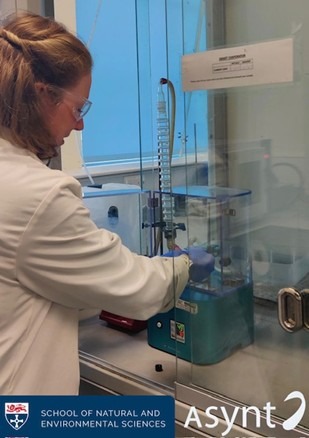
The work reflects the realities of modern medicinal chemistry, where the rapid design, synthesis and optimisation of multiple structurally related compounds is essential to understanding structure activity relationships and progressing the most promising candidates. These programmes demand not only scientific rigour, but efficient, reproducible laboratory workflows.
https://pubs.acs.org/doi/10.1021/acs.jmedchem.5c02924
This type of research is inherently iterative and operationally demanding. Designing, synthesising and refining multiple compound analogues requires reliable heating, repeated solvent removal, careful purification workflows and reproducible reaction conditions, often across many parallel synthetic steps where consistency is critical.
It is precisely in this kind of environment that practical laboratory infrastructure can make a meaningful difference.
Medicinal chemistry programmes depend on momentum. When teams are synthesising and evaluating multiple compounds in fast moving discovery projects, reproducibility, efficiency and safe laboratory workflows become just as important as the chemistry itself.
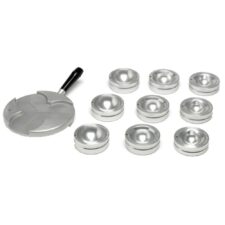
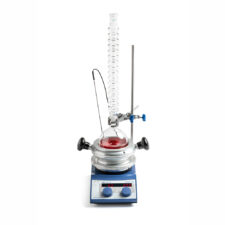
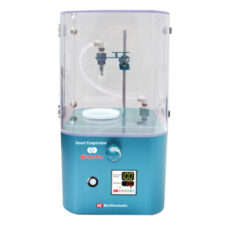
Throughout this work, practical technologies from Asynt, including DrySyn heating blocks, waterless condensers, Spiral Evaporator and Smart Evaporator, supported day to day synthetic operations in a way that aligned well with the demands of the programme.
DrySyn heating blocks provided clean, reproducible heating without the mess and hazards associated with traditional oil baths, creating a safer and more practical working environment while maintaining reliable thermal control across repeated reactions. For a busy medicinal chemistry laboratory, removing the risk of hot oil spillages and slippery surfaces is a meaningful operational advantage.
The use of waterless condensers also complemented this approach well, eliminating the need for continuous water cooling, reducing water consumption and removing the risk of leaks or flooding, an important consideration in both sustainability and everyday laboratory management.
Efficient solvent removal was equally important in supporting compound progression, where the Smart Evaporator helped streamline evaporation workflows and reduce bottlenecks during synthesis and purification.
While scientific publications rightly focus on the chemistry and biological outcomes, the practical infrastructure supporting that work often plays a quietly important role. In complex medicinal chemistry programmes, dependable equipment that improves reproducibility, supports safer working practices and helps laboratories operate more sustainably can make a real difference to research productivity.
If you’d like any further information regarding any of these chemistry tools, please don’t hesitate to contact us via the Live Chat here at Asynt.com or email [email protected].