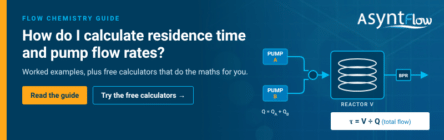
How do I calculate residence time and pump flow rates?
Getting residence time and pump flow rates right is the foundation of every successful flow chemistry experiment. Let us help you with that!
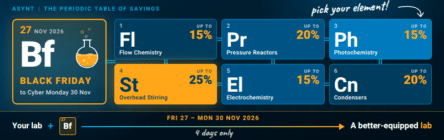
We’re doing Black Friday 2026 a little differently for your lab needs this year.
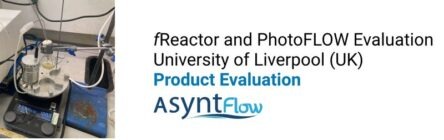
Alex Padgham, University of Liverpool (UK) explains how the fReactor and PhotoFLOW module support heterogeneous photochemistry in a compact flow setup
From intern to lab lead How Northeastern University London is building sustainable teaching lab practice with Asynt CondenSyn® and the CondenSyn Distillation Adapter THE CHALLENGE Daniela Brandao de Ceita (Dani),
Real-time reaction insight under flow conditions with FlowUV
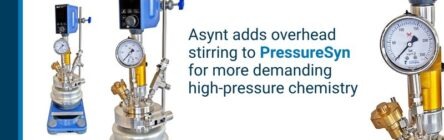
The updated modular PressureSyn introduces an optional overhead stirring manifold, addressing a limitation of magnetic stirring in demanding high-pressure reactions.
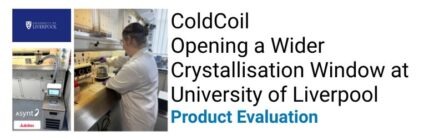
University of Liverpool chemist, Meg, explains how our ColdCoil supports temperature-controlled co-crystallisation in flow.
Dr Bartosz Bieszczad and Pratik Avinash from UCD evaluated the Illumin8 in their lab and kindly shared their feedback…
At the heart of the Flow Chemistry revolution are advanced instruments like the continuous stirred tank reactor (CSTR). Want to know more about them?
This inaugural edition of Asynt Research Highlights celebrates the work of Omar Mohammad and colleagues at Aston University, who systematically modernised the classical Kolbe–Schmitt reaction for contemporary carbon utilisation research.