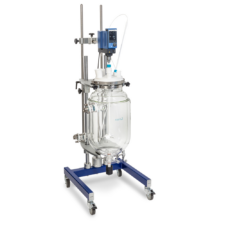
Asynt’s ReactoMate support systems are designed to provide reliable, safe and stable operation for a wide range of jacketed reactors. To ensure long service life and optimal performance, regular checks, correct handling and ReactoMate cleaning and maintenance is essential.
General Care of ReactoMate Systems
ReactoMate units are engineered to give clear visibility of your vessel and secure support during laboratory-scale reactions. All mechanical components, including frames, clamps, stirrer alignment mechanisms and drip trays (where supplied), should be inspected routinely. Metal parts are typically manufactured from stainless steel, aluminium or anodised aluminium and should be kept clean and free from chemical residues.
Consumable parts such as seals, O-rings, PTFE components and stirrer guides will naturally wear over time. Keeping a small stock of spares helps minimise downtime. Check seals and O-rings regularly, especially when working at the extremes of temperature, as these conditions can cause materials to harden or degrade. For extended high-temperature work above 150°C, a high-performance material such as Chemraz may be recommended.
It is the user’s responsibility to confirm chemical compatibility of all wetted materials before use. Standard wetted materials in ReactoMate systems include borosilicate glass, PTFE, FEP and other fluoropolymers. Compatibility charts are widely available or ask us and we can provide assistance.
Thermal Considerations
To protect your vessel from thermal shock, avoid excessive temperature differentials between the jacket and the reaction mixture. When adding reagents, ensure the feed material is at a similar temperature to the vessel contents where practical. Pre-cooling or pre-heating additions may be required for safe control.
Pressure and Vacuum Safety
Glass jacketed reactors must not be over-pressurised. Asynt recommends a maximum working pressure of 0.5 bar above atmospheric pressure. Users should also consider the pressure generated by the recirculating cooler or circulator. Some temperature control units can exceed the safe limit; a bypass line or pump setting adjustment may be necessary.
For inert operations, a gas bubbler or appropriate pressure-relief device helps prevent internal pressure build-up while maintaining an oxygen-free environment.
When working under vacuum, unused lid sockets can be fitted with glass stoppers to improve the achievable vacuum level.
Static Electricity
Static build-up may occur when circulating certain heat transfer fluids, particularly in low-conductivity systems. Users should follow best practice to minimise static and use appropriate earthing where required.
Cleaning Your Reactor
Good cleaning practice is essential to protect your equipment and ensure reproducible reaction conditions. Prompt cleaning prevents corrosion, keeps components in good condition and reduces wear on seals and joints.
General Cleaning Steps
- Rinse glassware with a suitable organic solvent (e.g. acetone or ethanol) to remove organic residues. Dispose of solvent waste appropriately.
- Wash using warm soapy water and a suitable brush. This waste water may usually be disposed of to drain.
- Rinse thoroughly with deionised water to avoid water marks. A clean vessel should show good sheeting with DI water; if not, further cleaning is required.
- A final acetone rinse may be used to speed drying.
Cleaning is typically easier when carried out immediately after use. Laboratory glassware detergents such as Liquinox or Alconox are suitable when detergents are required.
Cleaning Common Residues
• Water-soluble solutions: Rinse 3–4 times with deionised water.
• Water-insoluble solutions: Rinse 2–3 times with acetone or ethanol, then 3–4 times with deionised water.
• Strong acids: Rinse carefully with copious tap water under a fume hood, followed by several DI water rinses.
• Strong bases: Rinse thoroughly with tap water, then several DI water rinses.
• Weak acids: Rinse 3–4 times with deionised water.
• Weak bases: Rinse with tap water, then with deionised water.
Final Notes
Regular inspection, correct cleaning and attention to consumables will significantly extend the life of your ReactoMate system and ensure safe, reliable operation across all reaction conditions. Discover the range, designed to suit your chemistry, here: https://www.asynt.com/products/jacketed-lab-reactors/.