Getting residence time and pump flow rates right is the foundation of every successful flow chemistry experiment.
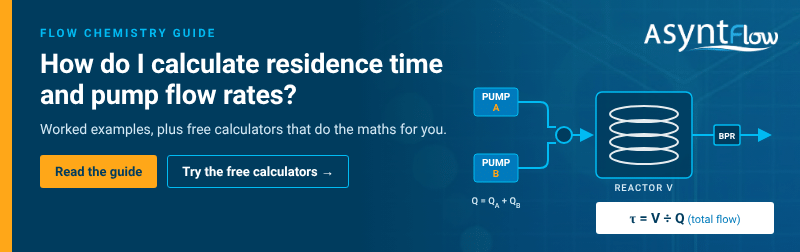
In batch chemistry, reaction time is simply how long the flask stays on the stirrer hotplate. In flow, time becomes a function of reactor volume and pump flow rate, and the stoichiometry of your reaction is set by the relative flow rates of each reagent stream. This post walks through the basic calculations, then shows how the free Asynt Flow Chemistry Calculators can do the work for you.
What is residence time?
Residence time is the average time your reaction mixture spends inside the heated or cooled reactor. It is the flow equivalent of reaction time, and it is calculated with one simple equation:
Residence time (min) = Reactor volume (mL) ÷ Total flow rate (mL/min)
For example, a 10 mL coil reactor fed at a combined flow rate of 1 mL/min gives a residence time of 10 minutes. Double the flow rate to 2 mL/min and the residence time halves to 5 minutes. Rearranging the equation tells you the total flow rate needed for a target residence time:
Total flow rate (mL/min) = Reactor volume (mL) ÷ Residence time (min)
Remember that it is the combined flow of every stream entering the reactor that counts. Two pumps each running at 0.5 mL/min into a 10 mL reactor still give a 10 minute residence time.
How do I calculate the flow rate for each pump?
Once you know the total flow rate, you need to split it between your pumps so that the reagents meet in the correct molar ratio. The flow rate of each stream is proportional to the equivalents required divided by the concentration of that stock solution.
Take a reaction where reagent A (0.5 M) is the limiting reagent at 1.0 equivalent, and reagent B (1.0 M) is used at 1.2 equivalents, with a total flow rate of 1 mL/min:
- Ratio of streams: A = 1.0 ÷ 0.5 = 2.0 and B = 1.2 ÷ 1.0 = 1.2, giving a ratio of 2.0 : 1.2.
- Pump A: 1 mL/min × 2.0 ÷ 3.2 = 0.625 mL/min, delivering 0.3125 mmol/min of A.
- Pump B: 1 mL/min × 1.2 ÷ 3.2 = 0.375 mL/min, delivering 0.375 mmol/min of B, exactly 1.2 equivalents.
For a two step sequence, the second reactor receives the combined flow from all upstream pumps plus any new reagent stream, so its residence time is its volume divided by that larger total flow rate. This is where the arithmetic quickly becomes time consuming.
Don’t forget the connecting tubing
The tubing between your pumps, mixers and reactors holds liquid too. That volume does not usually count towards residence time at reaction temperature, but it does delay when each reagent reaches the mixing point and when product reaches your collection vessel. Knowing these delay times helps you decide when to start collecting steady state material and avoids wasting reagent.
Using temperature to shorten residence time
One of the key advantages of flow chemistry is the ability to heat solvents safely above their atmospheric boiling point by fitting a back pressure regulator. Because reaction rate rises with temperature, as described by the Arrhenius equation, a reaction that needs hours under reflux in batch can often be completed in minutes in flow. As a common rule of thumb, rate roughly doubles for every 10 °C increase, although the exact effect depends on the activation energy of your reaction.
Two questions follow: how much shorter can the residence time be at a higher temperature, and how much back pressure do you need to keep the solvent liquid? Both can be estimated before you run a single experiment.
Let the Asynt Flow Chemistry Calculators do the maths
To save time at the planning stage, Asynt provides three free online calculators that work without any software or automation:
- Flow Rate Calculator: Configures fluidic paths for up to two step reactions and calculates the pump flow rates you need from reactor volumes, reagent molarities, stoichiometry and residence times. You can even enter the length of your connecting tubing.
- Reaction Time Calculator: Uses the Arrhenius rate equation to estimate the residence time needed at a new temperature, or the temperature needed for a new residence time, from your current conditions.
- Back Pressure Calculator: Estimates the minimum pressure required to keep your chosen solvent liquid at your working temperature, with an ‘Other’ option for solvents not listed.
Try the Flow Chemistry Calculators
These calculators give estimates intended as a guide for planning. We always recommend confirming conditions experimentally and working within the pressure and temperature ratings of your equipment.
Interested in flow chemistry?
Asynt is a team of chemists who design and supply equipment for chemists, and our flow chemistry range covers everything from first steps in flow to multistep synthesis. Explore our flow chemistry products to find the right system for your lab.
If you would like help planning your conditions or choosing equipment, our technical sales team would be happy to talk it through. Use the live chat, our contact form, or book time with us.