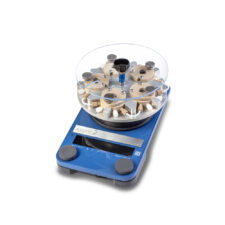
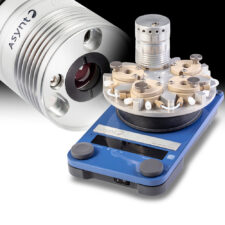
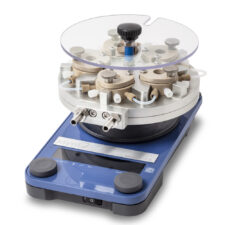
Alex Padgham, University of Liverpool (UK) explains how the fReactor and PhotoFLOW module support heterogeneous photochemistry in a compact flow setup
RESEARCH AIMS
We used the fReactor with the PhotoFLOW to investigate the catalytic potential of solid-state organic photo-catalysts, along with a separate copper alkyne coupling reaction. Our aim was to explore the efficacy of a photo-flow reactor that could handle heterogeneous mixtures and to establish the efficiency of the reactions with shorter light exposure times.
SIMPLE SET UP, LOW RISK OF BLOCKAGES
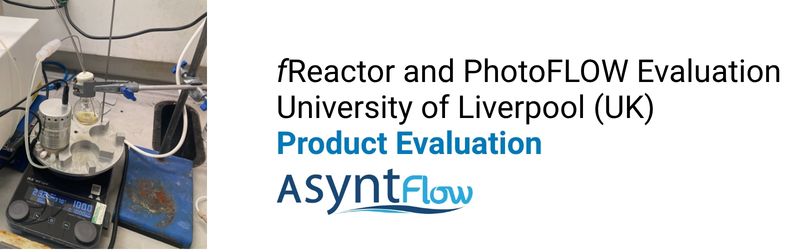
The system was straightforward to set up, with no extra footprint beyond the pump and a hot plate, which was then easy to adapt to our requirements, allowing us to explore flow rate and residence time. We found the combination of the fReactor and PhotoFLOW particularly useful for reactions involving heterogeneous catalysts, which could be explored with a low risk of blockages, running for up to 10 hours without complication.
PROOF OF CONCEPT RESULTS
During the project, we were able to collect proof of concept data on a copper catalysed alkyne coupling reaction that showed flow reactors could be effective for this chemistry, with good results even without an optimisation of conditions. The hope is that this methodology will be expanded and could incorporate PhotoFLOW reactors using different wavelengths to target a wider scope of substrates. Unfortunately, the solid-state organic photo-catalysis was less successful, with the short residence times, combined with only one optimal wavelength PhotoFLOW reactor, negating any significant reactivity. It is predicted that having more fReactors in series would improve the outcome, as the comparative batch reaction requires a higher power lamp and long reaction times, with less scalability possible.
A COMPACT PHOTOREACTOR
Overall, this system gave us access to a small footprint photo-reactor that was simple to setup, easy to use, and targeted the specific wavelengths of light required for our chemistry. The ability to use heterogeneous catalysts in a photo flow reactor is hoped to be exploited further in the future.
“We found the combination of the fReactor and PhotoFLOW particularly useful for reactions involving heterogeneous catalysts, which could be explored with a low risk of blockages, running for up to 10 hours without complication.”
Alex Padgham, PDRA in the Slater Group, University of Liverpool
CUSTOMER PERSPECTIVE
“We used the fReactor with the PhotoFLOW to investigate the catalytic potential of photo-activated solid-state organic catalysts, along with a separate copper alkyne coupling reaction. Our aim was to explore the efficacy of a photo-flow reactor that could handle heterogeneous mixtures and to establish the efficiency of the reactions with shorter light exposure times.
The system was straightforward to set up, with no extra footprint beyond the pump and a hot plate, which was then easy to adapt to our requirements, allowing us to explore flow rate and residence time. We found the combination of the fReactor and PhotoFlow particularly useful for reactions involving heterogeneous catalysts, which could be explored with a low risk of blockages, running for up to 10 hours without complication.
During the project, we were able to collect proof of concept data on a copper catalysed alkyne coupling reaction that showed flow reactors could be effective for this chemistry, with good results even without an optimisation of conditions. The hope is that this methodology will be expanded and could incorporate PhotoFLOW reactors using different wavelengths to target a wider scope of substrates. Unfortunately, the solid-state organic photo-catalysis was less successful, with the short residence times, combined with only one optimal wavelength PhotoFlow reactor, negating any significant reactivity. It is predicted that having more fReactors in series would improve the outcome, as the comparative batch reaction requires a higher power lamp and long reaction times, with less scalability possible.
Overall, this system gave us access to a small footprint photo-reactor that was simple to setup, easy to use, and targeted the specific wavelengths of light required for our chemistry. The ability to use heterogeneous catalysts in a photo flow reactor is hoped to be exploited further in the future.”
Explore the fReactor Photo Flow: https://www.asynt.com/product/freactor-photo-flow/ or contact us to discuss your chemistry.
Request more info
Asynt reference: ASY-CS-209