Accelerating photochemical reaction development
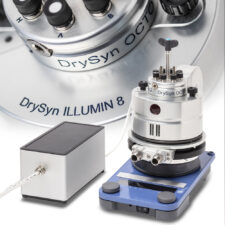
University College Dublin evaluates the Asynt Illumin8 for parallel screening, reproducibility, low-temperature operation and laboratory safety.
Download in PDF format here: ASY-CS-205 UCD Illumin8 Testimonial
| INDEPENDENT EVALUATION
Researchers from UCD’s School of Chemistry assessed the Illumin8 over several weeks for reaction screening, optimisation, reproducibility and reduced-temperature operation. Evaluation team: Dr Bartosz Bieszczad and Pratik Avinash COMMERCIALLY RELEVANT OUTCOMES
|
WHAT THE UCD RESEARCHERS SAID
“The Illumin8 provided an excellent platform for rapid optimisation and reaction screening. Being able to run multiple experiments in parallel significantly improved workflow efficiency and accelerated decision-making during reaction development.”
“Operation at 0°C was reliable and straightforward, making the system suitable for photochemical reactions where thermal control is essential.”
“Reproducibility between experiments was excellent, which is critical when comparing reaction conditions during optimisation studies.”
“The safety-focused design makes the system much easier to use in a standard laboratory setting. The interlocked enclosure provides confidence during operation without requiring cumbersome additional shielding.”
“Overall, the Illumin8 proved to be an excellent tool for photochemical reaction development. Its parallel screening capability substantially improved optimisation speed, reproducibility was consistently strong, operation at low temperature was effective, and the built-in safety features made day-to-day use straightforward and practical.”
Evaluation team, School of Chemistry, University College Dublin
Asynt reference: ASY-CS-205