How does the chemistry of fireworks affect the colour?
As Bonfire Night and New Year celebrations approach, fireworks light up the skies with dazzling displays — but have you ever wondered what gives them their brilliant colours and explosive power?
In a fascinating article by chemistry educator Andy Brunning, published on Compound Interest, the science behind fireworks is broken down into its key components: metal salts, oxidisers, and binders.
Colourful Chemistry: Metal Salts at Work
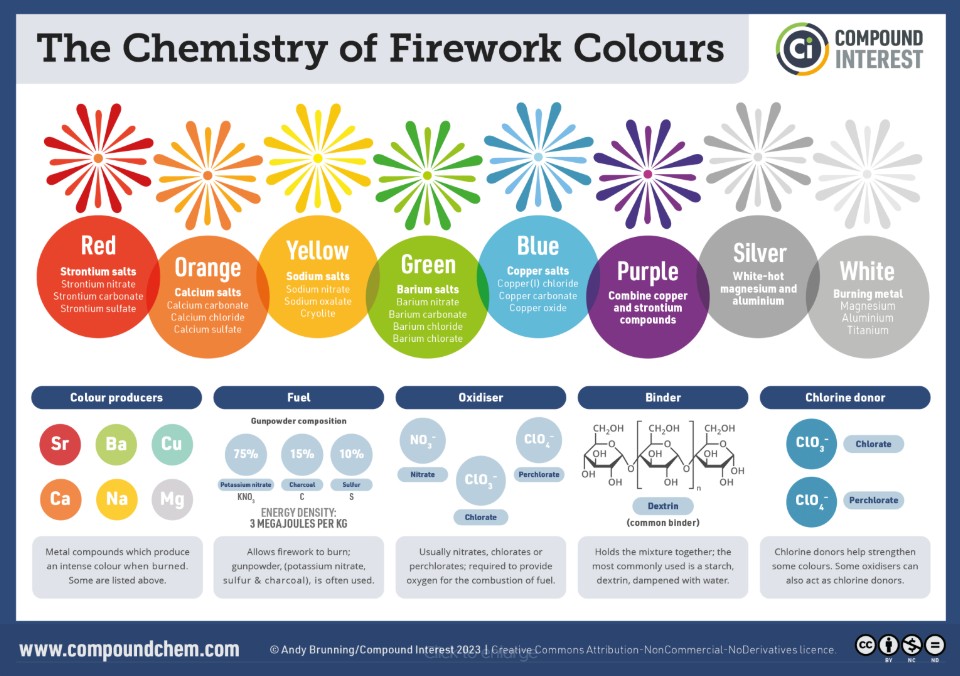
The vibrant colours in fireworks come from metal salts; compounds made of metal and non-metal atoms bonded together. When heated, the electrons in these metal atoms become excited and jump to higher energy levels. As they return to their original state, they release energy in the form of light.
Here are a few examples:
- Strontium salts produce red
- Barium compounds give green
- Copper salts create blue (though these are tricky to stabilise)
- Sodium compounds emit yellow
Interestingly, blue fireworks are considered a mark of quality due to the instability of copper compounds at high temperatures.

The Power Behind the Bang: Black Powder
The explosive force in fireworks comes from black powder, a mixture of:
- Potassium nitrate (saltpetre) – the oxidiser
- Charcoal – the fuel
- Sulfur – another fuel and stabiliser
This combination has remained largely unchanged since the 18th century. The reaction is complex, producing gases like carbon dioxide, nitrogen, and water vapour, which propel the firework into the sky.
Binders & Stability
To hold everything together and reduce sensitivity to shock, fireworks include binders; often organic compounds like dextrin. These also act as additional fuel once ignition occurs.
More Than Just a Bang
The article also highlights how moisture content and pellet size can affect burn time, and how oxidising agents like chlorates and perchlorates help sustain combustion.
For a deeper dive into pyrotechnic chemistry, Andy recommends “The Chemistry of Fireworks” by Michael S. Russell, available via the Royal Society of Chemistry.
References & Further Reading
- The Chemistry of Fireworks – Compound Interest
- The Chemistry of Fireworks by Michael S. Russell (RSC Publishing)
- The Chemistry of Pyrotechnics by John A. Conkling
About the Author
This post is inspired by the work of Andy Brunning, a chemistry educator and creator of Compound Interest; a site dedicated to making chemistry accessible and engaging through infographics and articles.