Welcome to the Asynt June 2026 Chemistry Newsletter:
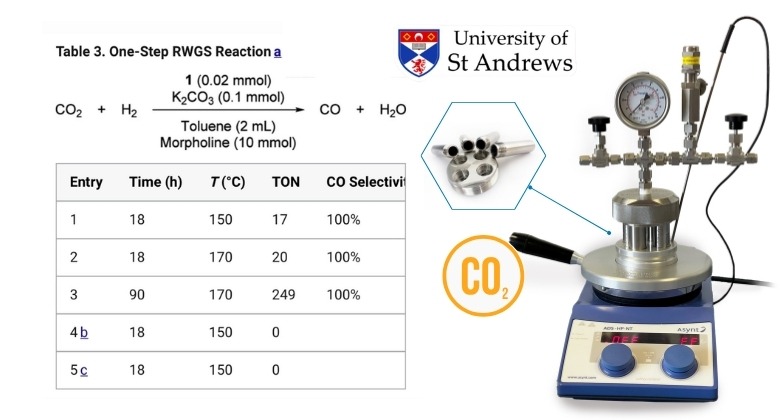
Turning CO2 Into Opportunity.
At the School of Chemistry | University of St Andrews, Amit Kumar, Ph.D’s group is exploring how advanced catalytic chemistry can help unlock more efficient CO₂ utilisation.
Using Asynt’s Quadracell high pressure reactor, the team has been able to improve the efficiency of the reverse water gas shift reaction, converting CO₂ into valuable chemical feedstocks under controlled reaction conditions.
Why does this matter?
The reverse water gas shift reaction is attracting growing interest as a route to transform captured carbon into useful building blocks for fuels and chemicals, helping bridge the gap between sustainable chemistry and real-world application.
Quadracell gives researchers the flexibility to explore multiple reaction conditions simultaneously, accelerating optimisation while maintaining precise control over pressure and temperature. For teams tackling complex catalytic challenges, that combination of parallel experimentation and robust engineering can make all the difference.
It’s always brilliant to see innovative research groups pushing boundaries and using the right tools to move ideas forward.
Read the full evaluation here: https://www.asynt.com/evaluations/quadracell.
Asynt at PCI Days, Warsaw.
We are excited to be heading to PCI Days in Warsaw alongside our fantastic distributors Donserv.
This leading industry event brings together professionals from across the pharmaceutical, cosmetics and manufacturing sectors, making it a brilliant opportunity to explore new ideas and technologies.
Donserv will be showcasing the Asynt product range on the stand, highlighting practical solutions designed to improve efficiency, safety and sustainability in the lab. If you are attending, be sure to stop by and discover how our technologies support smarter chemistry.
Events like PCI Days also reflect the strength of Asynt’s global distribution network, allowing us to work closely with trusted partners worldwide to bring innovative solutions directly to our customers.
Find out more about the event here: https://pcidays.pl/
Find Your Local Asynt Distributor

World Environment Day 2026.
World Environment Day takes place each year on the 5th June, bringing together people, organisations and industries around the world to focus on protecting our planet and driving meaningful environmental change.
Established by the United Nations, it has grown into the largest global platform for environmental awareness and action, inspiring innovation, responsibility and progress across every sector.
For chemists, sustainability is no longer a future ambition. It is an essential part of how we design experiments, develop processes and choose the tools we use every day. At Asynt, environmental responsibility sits at the heart of our approach, guiding how we develop technologies that help laboratories reduce their environmental footprint without compromising performance.
Many of our solutions are specifically designed to support greener workflows. Products such as our waterless air condensers (CondenSyn) eliminate the need for continuous cooling water, dramatically reducing water consumption while also improving laboratory safety by removing the risks associated with traditional tap water systems. Alongside this, our focus on efficient heating, smarter temperature control and practical design helps reduce electrical demand, streamline workflows and encourage more sustainable laboratory practices.
World Environment Day is a powerful reminder that small, practical changes can deliver meaningful impact. By designing equipment that helps scientists work more efficiently, use fewer resources and operate more safely, we are committed to supporting a greener future for chemistry and the communities it serves.
Saving the planet doesn’t have to cost the earth.
Find Out More About Sustainability At Asynt
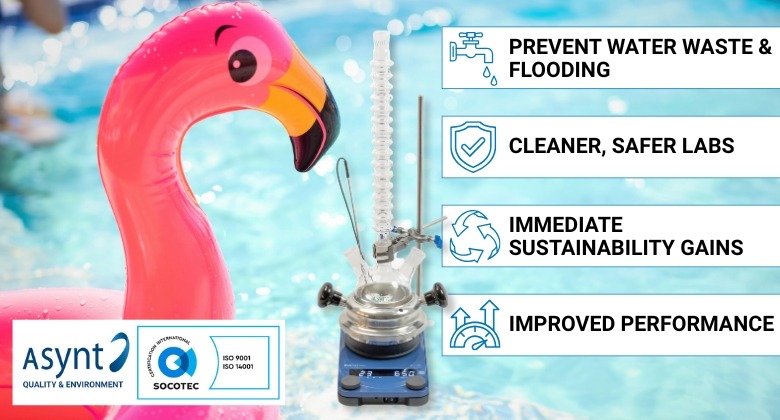
CondenSyn Range: Rethink Reflux, Save Water, Simplify Your Lab.
Have you ever considered how much water runs straight down the drain during a standard reflux experiment?
A traditional water-cooled condenser can easily use around 0.5 litres of tap water per minute. Over the course of a working day, that can mean 250 to 300 litres of water used for just one reaction setup. Multiply that across a busy lab and you are quickly talking about thousands of litres, equivalent to draining a small swimming pool over surprisingly short periods of time.
The CondenSyn range from Asynt offers a smarter alternative. Designed as a waterless air condenser, CondenSyn uses intelligent glass geometry and natural air cooling to efficiently condense vapours without the need for running water. The result is a cleaner, safer and more sustainable reflux setup that reduces both environmental impact and laboratory clutter.
Researchers who have adopted CondenSyn consistently highlight the practical benefits. Users report significant water savings, easier setups and improved peace of mind by eliminating the risk of flooding from cooling water hoses. One chemist noted that switching to CondenSyn for refluxing saved hundreds of litres of water each day while maintaining excellent performance. Others have praised its simplicity, reliability and the immediate sustainability gains it delivers.
It’s especially popular in teaching labs.
The CondenSyn family includes options to suit a wide range of reaction scales, from compact systems for small flasks through to larger condensers capable of handling more demanding applications used on glass jacketed reaction vessels. Each is designed with the same goal in mind: helping chemists work more efficiently while dramatically reducing water consumption.
If one traditional condenser can waste enough water in a day to fill several household bathtubs, imagine the impact across a year. Small changes to equipment can deliver big environmental benefits without changing the chemistry itself.
Explore The Full CondenSyn Range
If you’d like further information about anything here, or support from the Asynt technical team, you’re welcome to use the live chat on our website, email [email protected] or give us a call. We look forward to talking with you.