High pressure chemistry is key to a range of processes that would be far more difficult, or impossible under normal atmospheric conditions. Operating at these elevated temperatures and pressures, with often highly reactive chemicals requires specialised materials and design.
Running these reactions in parallel has a range of further benefit, allowing you to screen multiple reactions on a small footprint. Depending on the configuration of the reactor, you can run these reactions at the same, or various pressures and temperatures simultaneously.

The Multicell PLUS allows for a wide range of customisable options with up to 10 independent cells.
Materials:
As mentioned, high pressure reactors require very durable materials to operate effectively and safely. Three of the most common materials are:
- 316 Stainless steel – 316 Stainless is the most used of the three materials. It contains iron, chromium, nickel and molybdenum, added to improve corrosion resistance.
- Inconel – Inconel is a superalloy, meaning that it can continue to operate effectively at a high fraction of its melting point. It’s primarily composed of nickel, iron and chromium.
- Hastelloy – Hastelloy is the most corrosion resistant of the three. It’s also a superalloy composed of nickel, chromium, molybdenum, often tungsten and other elements.
In addition to these alloys being used for the superstructure of the reactor, liners can be used to further protect the interior of the reactor from corrosion. These are available in borosilicate glass and PTFE and can be made custom to fit your pressure reactor.

A single position high pressure reactor with an optional PTFE liner
Further customisation of parallel pressure reactors:
Along with the various alloys and liners, a range of other features are available on our parallel pressure reactors. These include:
- Heating – via heating mantle or hotplate
- Cooling – via a circulator
- Agitation – magnetic or overhead stirring
- Sampling/additions – while under pressure
- Condensing
- Liquid charging
- Gas sampling
- Independent or connected cells – excellent for screening

This parallel pressure reactor was custom made with the capacity of independent pressure control in each cell
Processes that use high pressure chemistry:
- Hydrogenation – In industries from food production to pharmaceuticals and petrochemicals, hydrogenation reactions often gain significant advantages from elevated pressures. Higher pressures improve hydrogen gas solubility in liquid systems and can enhance catalyst activity, leading to more efficient processes.
- Oxidation – Operating under pressure can make oxidation reactions more effective, whether producing aldehydes, ketones, or carboxylic acids. This approach often results in better yields and greater selectivity.
- Polymerisation – Many commercial polymerisation processes, such as converting ethylene into polyethylene, rely on high pressures to deliver polymers with the desired properties.
- Cracking – In petroleum refining, high-pressure catalytic cracking is an essential method for breaking large hydrocarbon molecules into smaller, high-value products such as petrol.
- Specialised chemical and pharmaceutical synthesis – Certain complex transformations, including chiral hydrogenations and cyclisation reactions for active pharmaceutical ingredients (APIs), are made possible or more efficient by high-pressure conditions.
- Catalyst development – Researchers use high-pressure setups to evaluate and design new catalysts, particularly for reactions involving gases like hydrogen or carbon monoxide.
- Advanced organic synthesis – Techniques such as the Diels–Alder reaction, cycloadditions, and pressure-induced rearrangements can be carried out more readily under high-pressure conditions, broadening the synthetic options available to chemists.
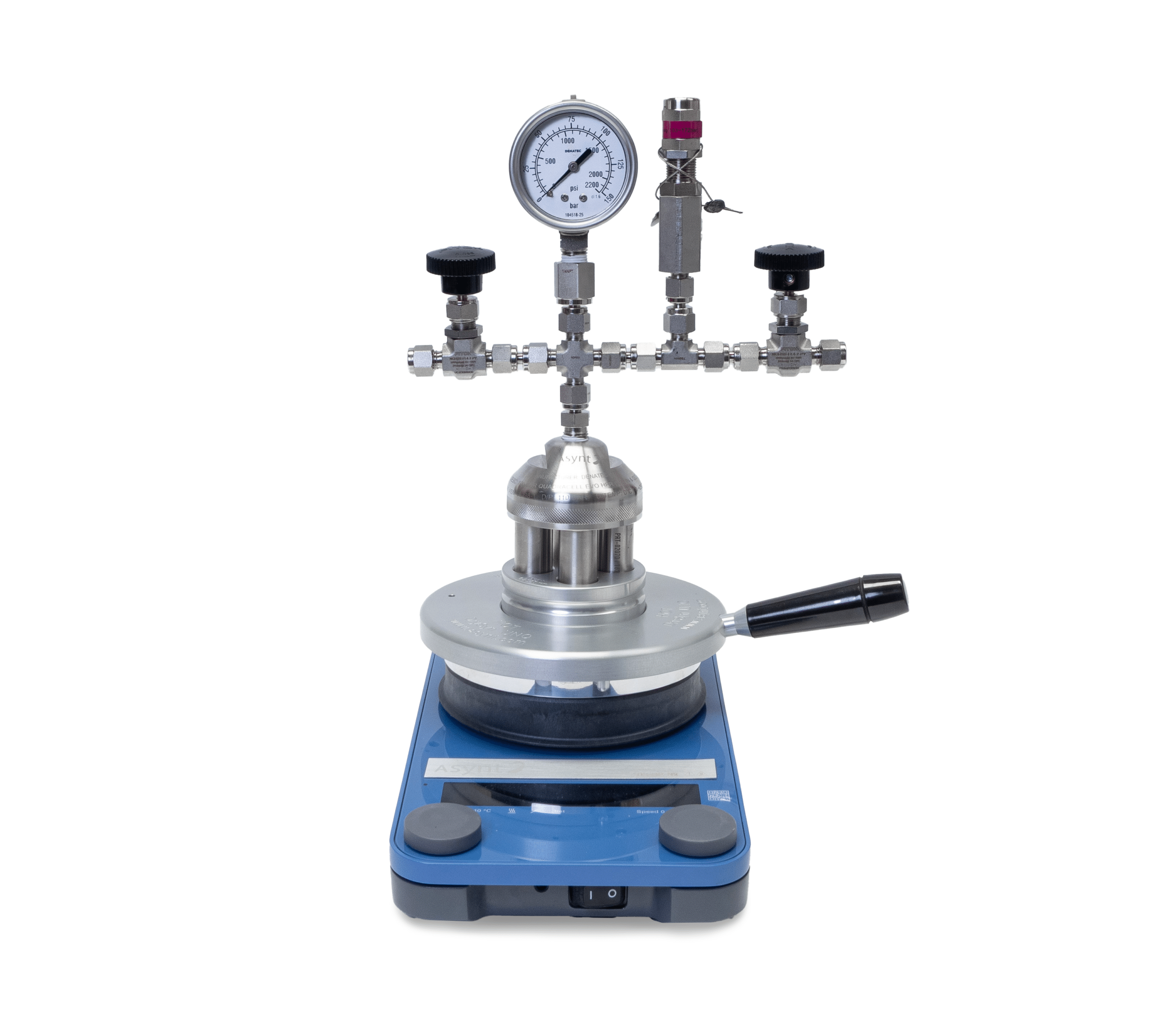
Our Quadracell 4 position reactor
Asynt’s Range:
Asynt have a wide range of both standard and custom high pressure reactors. These include:
- Quadracell – our smallest, standard pressure reactor. The Quadracell features 4 10 mL cells, constructed from stainless steel or Hastelloy. It has an operating temperature of up to 250 °C and maximum pressure of between 50 and 200 bar depending on configuration.
- Multicell – the next step up in scale from our Quadracell. The Multicell offers the user the ability to screen 10 x 30 mL reactions at pressures of up to 50 bar and up to 200 °C
- Multicell PLUS – a larger and more customisable version of the Multicell. The PLUS has 8 x 30 mL cells as standard, but 4, 6, and 10 cell arrangements possible with individual cell volumes up to 100 mL. The standard unit operates up to 50 bar and temperatures up to 200 ºC but options up to 200 bar and temperatures of 300 ºC and beyond are available.
- Custom Multicell – this tool offers cost-effective custom reactor, providing the user with the ability to screen 10 x 30 mL reactions at pressures of up to 100 bar or 200 bar as standard but this can be extended with a wide range of customisation options.
- Molten Salt Reactor – molten salt reactors are designed to operate at very high temperatures, potentially exceeding 800 ºC. Asynt designs these tools fully custom.
- Integrity 10 – our Parallel Pressure Reactor Module system allows users to vary the pressures at which they conduct experiments in devices such as the Integrity 10 or similar parallel reaction systems, offering up to 100 bar as standard.

The Integrity 10 with pressure reactor modules
Conclusion:
High pressure reactors open avenues to research that would be far more difficult at atmospheric pressure. With our range of tools, Asynt aims to support this research with robust, safe and precise equipment, while offering an array of options to suit your lab’s precise requirements. If you’d like to know more and have any questions, please don’t hesitate to get in touch. Email us at [email protected], call 011638781709 or send us a message in the live chat in the bottom right-hand corner!